
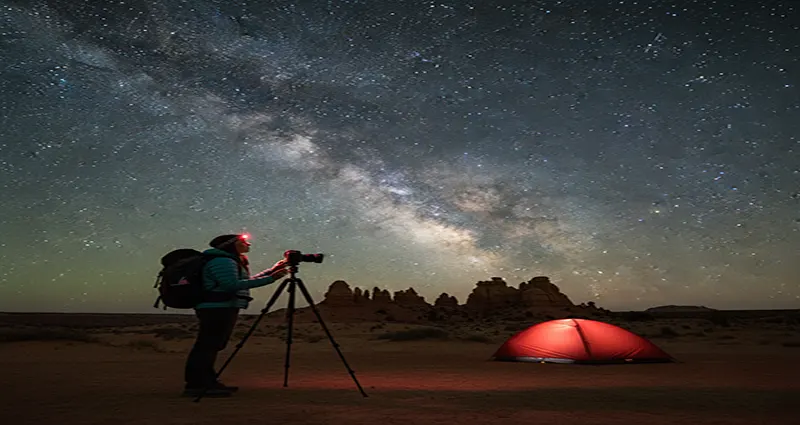
In our modern, brightly lit world, the profound experience of truly dark skies has become a rare luxury. Light pollution now obscures the faint glimmer of the Milky Way for 80% of North Americans. Yet, the vast, protected wilderness of the United States holds some of the planet’s most pristine viewing conditions, creating a paradise for astrophotography enthusiasts and amateur astronomers.
By choosing destinations officially designated for their darkness, you guarantee an unforgettable celestial experience. Here are two US national parks recognized for their exceptional skies, offering unique backdrops for your next astrotourism adventure.
🇺🇸 Destination 1: The Remote Gold Tier of Texas (Big Bend National Park)
Deep in the remote reaches of West Texas lies Big Bend National Park, holder of a coveted Gold Tier International Dark Sky Park designation. Its staggering lack of development and distance from any major city make it officially one of the darkest spots in North America.
- Darkness and Access: The park is far from any significant light sources, ensuring visibility of the Milky Way core, the Zodiacal Light, and countless deep-sky objects. The air is dry and relatively stable, contributing to high visual quality.
- Photographic Landscape: Big Bend offers dramatic foregrounds essential for compelling astrophotography compositions. The rugged peaks of the Chisos Mountains, the curves of the Rio Grande, and the unique silhouettes of desert flora create stunning contrasts against the vibrant night sky.
- Logistics Tip: Given its remoteness, planning is key. Ensure you have ample gas, water, and reservations, as infrastructure is minimal—which is exactly what keeps the skies so dark!
🇺🇸 Destination 2: The High-Altitude Clarity of Nevada (Great Basin National Park)
Tucked away in eastern Nevada, Great Basin National Park is another stellar location, renowned for its incredible high-altitude clarity. The park sits far from the Las Vegas lights and offers some of the clearest skies due to its elevation.
- High Altitude Advantage: With peaks climbing past 13,000 feet, the thinner atmosphere reduces light scattering and atmospheric distortion, providing superb astronomical clarity for observing faint objects. The park is designated as an International Dark Sky Park.
- Unique Foreground Subjects: Great Basin is home to the ancient Bristlecone Pines, some of the oldest living trees on Earth. Their gnarled, sculptural forms make them phenomenal, naturally textured subjects for creative long-exposure night shots.
- The Experience: The park actively embraces astrotourism, offering ranger-led astronomy programs and featuring an on-site observatory. Even if you don’t bring your own telescope, you can still experience true deep-sky viewing.
Essential Astrophotography Tips
Maximizing your dark-sky trip requires preparation. Keep these simple tips in mind:
- Check the Moon Phase: New Moon nights are mandatory for the best views of the Milky Way core. Plan your trip around this cycle.
- Use a Red Headlamp: Red light preserves your night vision (and the night vision of others) far better than white light. It’s a universal courtesy in any dark-sky park.
- Mind the 500 Rule: To take sharp, un-trailed photos of stars, divide 500 by your lens’s focal length (e.g., $500/20\text{mm} = 25$seconds max exposure).

